
Cylindrical Locks Demystified: A Complete Security Guide
When you think of a typical door lock, you're likely picturing a cylindrical lock. Found on countless residential and commercial doors worldwide, this type of lock is a cornerstone of modern security. But what exactly is a cylindrical lock, and is it the best choice for your needs? This comprehensive guide will dive deep into the world of cylindrical locks, giving you the knowledge you need to make an informed decision about your security.
What is a Cylindrical Lock?
A cylindrical lock, also known as a pin tumbler lock, is a locking mechanism that gets its name from its cylindrical shape. It's installed by drilling a hole through the door's face and a second hole into the edge of the door for the latch. The main body of the lock, which contains the locking mechanism and keyhole, sits inside the larger hole. This design makes them relatively easy to install and a popular choice for both new construction and retrofitting.
The core of a cylindrical lock is the cylinder or plug, which rotates when the correct key is inserted. This action retracts the latch bolt, allowing the door to open. The magic happens inside the cylinder, where a series of pins of different lengths (pins and tumblers) are arranged to prevent the plug from turning without the right key.
Key Components of a Cylindrical Lock
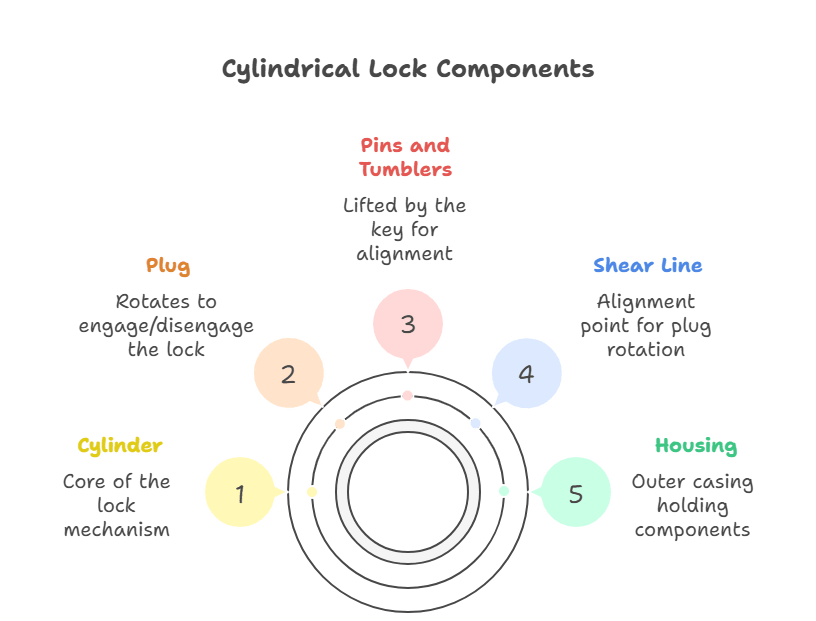
- Cylinder (or Core): The heart of the lock where you insert the key. It houses the pins and springs.
- Plug: The part that rotates within the cylinder to engage or disengage the lock.
- Pins and Tumblers: These are small metal pins, typically in two parts (a top pin and a bottom pin), that are pushed up by the key.
- Shear Line: This is the critical point where the top and bottom pins meet. When the correct key is inserted, it lifts the pins to precisely align with this line, allowing the plug to turn freely.
- Housing: The outer casing that holds all the internal components in place.
- Latch Bolt: The spring-loaded part that protrudes from the door edge and engages with the strike plate on the door frame to keep the door closed.
How a Cylindrical Lock Works ⚙️
The operation of a cylindrical lock is a clever display of mechanical engineering. Here's a step-by-step breakdown:
- Key Insertion: When you insert a key, the unique cuts (the "teeth") on the key's blade push the bottom pins to different heights.
- Pin Alignment: The correct key will lift each bottom pin so that its top aligns perfectly with the shear line. This creates a clear separation between the bottom and top pins.
- Rotation: With all the pins aligned at the shear line, the plug can now rotate freely inside the cylinder.
Latching and Unlatching: As the plug turns, it operates a cam that either retracts the latch bolt (to open the door) or extends it (to lock the door).
Types of Cylindrical Locks: Expanding on the Categories
Beyond the core functionality, cylindrical locks are categorized by their specific use cases and design.
By Functionality:
- Single-Cylinder Lock: This is the most common type. It has a keyhole on one side of the door (the exterior) and a thumb turn on the other (the interior). This provides convenience for quick exit but can be a security risk if there's a nearby window, as an intruder could break the glass and turn the latch.
- Double-Cylinder Lock: This lock requires a key on both the interior and exterior sides. While this offers enhanced security against break-ins through glass panels, it can be a significant safety hazard in emergencies like a fire, as you need a key to exit.
- Keyed Alike: This system allows one key to open multiple cylindrical locks. It's incredibly convenient for homes or businesses with multiple entry points, as you don't need to carry a bulky key ring.
- Master Key System: A more advanced version of "keyed alike." In a master key system, individual keys can open specific locks, but a single master key can open all the locks in the system. This is ideal for offices, schools, and apartment buildings where access control is essential.
By Type of Lock:
- Key-in-Knob/Lever Locks: The cylinder is integrated into the door knob or lever itself. These are typically used for residential interior doors or low-security exterior doors.
- Cylindrical Deadbolts: A separate, more robust lock with a cylinder. Deadbolts are considered more secure than standard knob locks because the bolt is "dead"—meaning it cannot be moved back into the door with a knife blade or other tool.
- Electronic Cylindrical Locks: These modern variants replace the traditional keyhole with a keypad, biometric scanner (fingerprint), or Bluetooth connectivity. They offer keyless convenience and can be integrated into smart home systems for remote access control and monitoring.
Cylindrical Locks: A Deep Dive into Security & Vulnerabilities
While widely used, cylindrical locks have faced scrutiny for their security vulnerabilities. Understanding these can help you choose the right level of protection.
- Lock Bumping: This is a technique where a special "bump key" is used to manipulate the pins and open the lock. Many modern cylindrical locks now come with anti-bump technology.
- Forced Entry: Cylindrical locks, especially older models, can be susceptible to forced entry methods like drilling or prying. The strength of the materials used in the lock is a key factor here.
- Key Duplication: Standard keys for cylindrical locks can be easily duplicated at most hardware stores, a security concern if a key falls into the wrong hands. High-security cylinders use patented keyways that prevent unauthorized duplication.
Cylindrical Lock vs. Mortise Lock: A Comprehensive Comparison
Choosing between a cylindrical lock and a mortise lock is a common dilemma. While they both secure doors, their design and security levels are vastly different.
Feature | Cylindrical Lock | Mortise Lock |
Installation | Simple, requiring two holes drilled through the door. | Complex, requires a large, precise pocket (mortise) to be cut into the door's edge. |
Security | Offers standard security; can be vulnerable to some attacks. | Highly durable and robust; generally offers superior security due to its contained, complex mechanism. |
Components | Latch and lock cylinder are separate units. | A single, self-contained unit (mortise box) contains the latch and deadbolt. |
Durability | Latch is spring-loaded and can wear over time. | Exceptionally durable and built to withstand heavy use. |
Cost | Generally more affordable. | More expensive due to complex design and installation. |
Application | Widely used in residential and low-to-medium security commercial settings. | Preferred for high-security applications, commercial buildings, and historic properties. |
Installation & Maintenance Tips
While cylindrical locks are user-friendly, proper installation and regular maintenance are key to their longevity and security.
Installation
- Mark the Door: Use the provided template to mark the center of the door's edge and face.
- Drill Holes: Carefully drill the two necessary holes, a large one for the lock body and a smaller one for the latch. Drill from both sides to prevent wood splitting.
- Install Latch: Insert the latch assembly into the hole on the door's edge and secure it with screws.
- Insert Lock: Slide the cylindrical lock body through the larger hole, making sure the latch assembly prongs engage with the lock mechanism.
- Install Trim: Secure the inner and outer trim plates (knob or lever) with the provided screws.
- Install Strike Plate: Align the strike plate on the door frame with the latch bolt and secure it.
Maintenance
- Lubrication: Annually, apply a graphite-based or silicone-based lubricant to the keyway and internal components. Avoid using oil-based lubricants like WD-40, as they can attract and trap dirt, leading to jams.
- Regular Cleaning: Use compressed air to blow out dust and debris from the keyhole.
- Inspect and Tighten: Periodically check for loose screws on the lockset, strike plate, and hinges, and tighten them to ensure proper alignment.
Replace Worn Keys: A worn-out key can damage the delicate pins inside the lock. If your key is bent or difficult to use, get a new one cut immediately.
Frequently Asked Questions (FAQs) about Cylindrical Locks
1. Can a cylindrical lock be rekeyed?
Yes, absolutely. One of the major advantages of a cylindrical lock is that a qualified locksmith can easily rekey it. This involves changing the internal pins to match a new key, a more cost-effective solution than replacing the entire lock.
2. Are cylindrical locks safe?
Cylindrical locks provide a standard level of security adequate for most residential and light commercial use. However, for higher security needs, pairing a cylindrical knob lock with a separate, high-security deadbolt is highly recommended.
3. What is the difference between a cylindrical lock and a tubular lock?
While they look similar, their internal mechanisms differ. A cylindrical lock has a more robust, two-piece mechanism with a spindle, while a tubular lock uses a simpler, single-piece spring-loaded bolt. Tubular locks are typically used for interior doors where no locking mechanism is needed.
4. What is a "key-in-knob" cylindrical lock?
A key-in-knob cylindrical lock is a type where the locking cylinder is integrated directly into the door knob itself. This is a common design for both residential and light commercial doors.
5. How do I know if my lock needs to be replaced?
Look for signs of wear and tear, such as a key that sticks or is difficult to turn, a latch that doesn't retract smoothly, or physical damage to the lock body. If the lock is older than 10-15 years or has been compromised in an attempted break-in, it's a good idea to replace it.
About Us & Contact
At Sef Lock, we are dedicated to providing the highest quality security solutions for your home and business. Our team of certified locksmiths and security experts is ready to assist you with everything from choosing the right lock to professional installation and maintenance.
Have more questions? Need a professional installation? Contact us our experts are just a call or click away.